


Preamble
In most meetings I’ve been in this year, a question keeps coming up: “Where are the capital flows in AI in emerging markets?”
Across the world, people asking were usually asking some version of “there isn’t enough capital, is there?”, and I mostly agreed with them. Being evidence-driven, and not finding any easy way to understand capital flows, we decided to go and look for ourselves.
In a way that was both “machine-ly” and “human-ly” possible, we started tracking every AI investment announcement and press clipping we could find from January 2023 to 15 August 2026 across Sub-Saharan Africa, South Asia, Southeast Asia, Latin America and the Caribbean, and the Middle East and North Africa. What began as six rows in an edition of Accendo Signals became the Accendo Signals Capital Flows Map, which holds 254 published records as of August 2026.
Within those records we identified 159 specific committed transactions. Of those, 144 disclose an amount, and those disclosed amounts total USD 42.77 billion. Separately we identified 53 committed capital envelopes, meaning national strategies, corporate country commitments, funds and other announced pools intended to be deployed over time. Forty-eight of those disclose a value, totaling USD 74.01 billion.
While we stated both numbers here, we have only focused on the 144 transactions with disclosed amounts. This is due to the fact that an individual investment can later become one of the transactions sitting inside a national strategy or a corporate commitment, and adding the two risks counting the same money twice.
What sounds like a methodological footnote turned out to be the beginning of the story. Once we stopped asking how much AI capital has been announced and started asking what kind of capital we can actually trace, where it is going and what it is financing, the market looked very different.
The headline is that there is a remarkable amount of capital. The equally important finding is that scarcity is real. Both are true. They are true of different parts of the same AI economy. And it creates real opportunities to find white-space to fund activities.
Hope you enjoy the read.
The AI stack is how we cut the data
We use the term “AI stack” to describe the layers that have to exist for AI to work in a market.
At the base is the energy infrastructure required to power everything else. Then comes compute infrastructure: data centers, GPU capacity, cloud regions and the processing capability on which AI runs. Above that sit data foundations, meaning datasets, local-language corpora and the other information required to make models useful in a specific context. Then come algorithms and AI models. Then applications and services, the things businesses, governments and people actually use. Across all of it sit human capacity and the policy and regulatory framework.
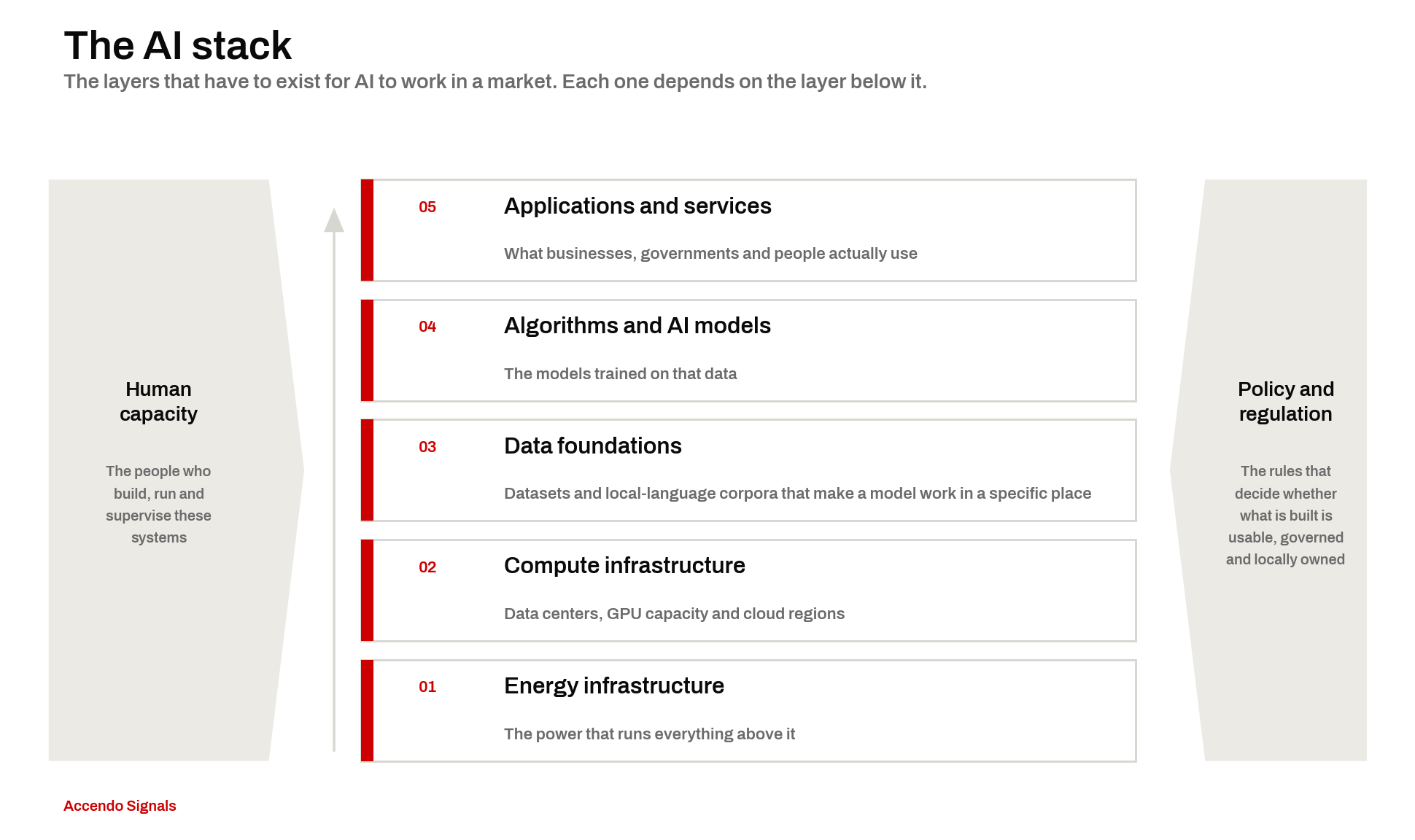
Every transaction on the map is tagged to one of these layers. The question the cut answers is not how much each layer costs, since a 300MW data center should cost vastly more than a speech dataset. It is whether each layer is attracting the kind of capital it needs to develop alongside the others. At the moment the answer looks decidedly uneven.
The AI capital paradox
The single biggest finding in the data is difficult to miss. 94% of all the capital we can trace to specific committed transactions is going into compute infrastructure: data centers, GPU clusters, cloud regions, AI factories, the processing capacity on which the rest of AI depends.
Compute accounts for only 34 of the 159 transactions, and those 34 carry USD 40.32 billion. Applications and services are almost the reverse, at 88 transactions, more than half the entire dataset, and USD 922 million, about 2.2 percent of traced capital. Data foundations account for 11 transactions and USD 79 million. Human capacity accounts for eight and USD 50.5 million.
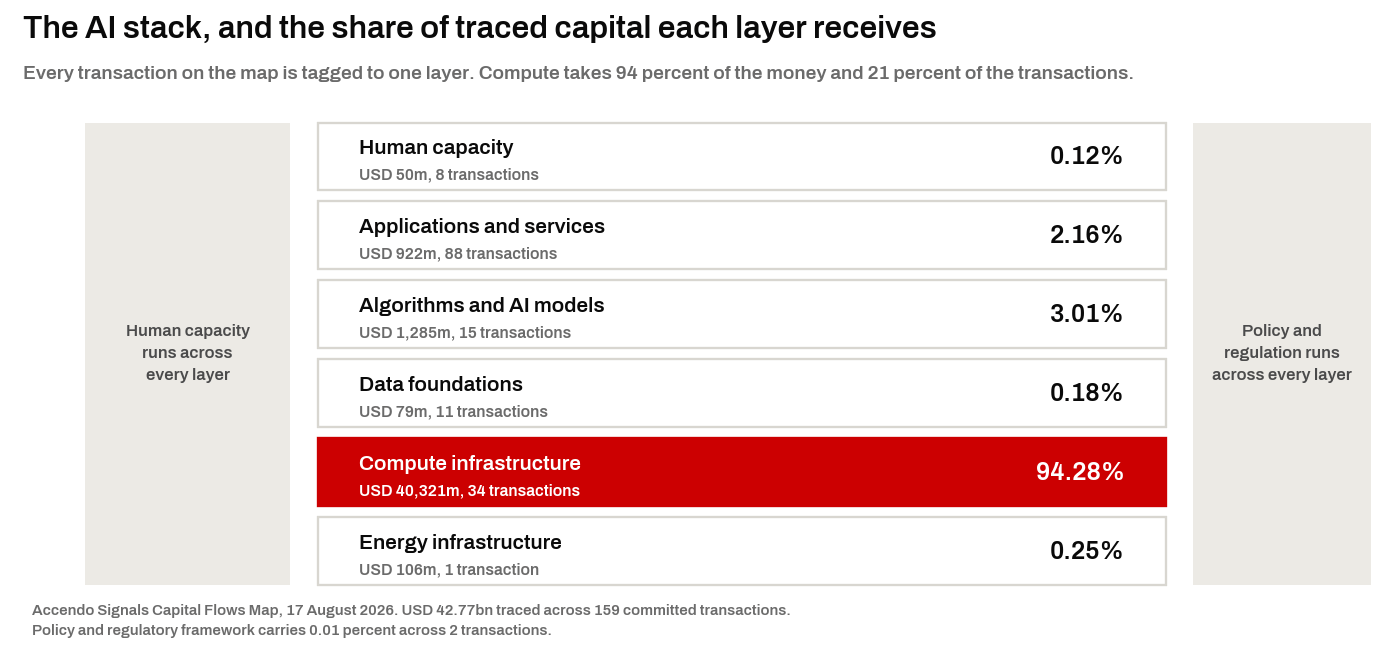
So a reader could look at the USD 42.8 billion headline and reasonably conclude that there is a “wall of money” going into AI in emerging markets. A founder in Nairobi, Dhaka, Cairo or Bogotá could look at exactly the same market and ask “what money?”. Both are describing the data accurately.
That is the paradox. Capital is extraordinarily abundant for a particular kind of AI asset and remarkably thin across much of everything built on top of it.
None of this is an argument against building compute. A country cannot have a domestic AI economy without processing capacity to run it on, any more than an economy can industrialize without power and roads. Compute is necessary. The data says plainly that it is not sufficient.
Four transactions carry half of everything we can trace
Interestingly, the concentration inside the USD 42.77 billion is also extraordinary. The 4 largest transactions account for 54% of the total, the largest ten for 77%, and the largest twenty for roughly 92%.
Every one of the ten largest is compute infrastructure. Not one is a dataset, a skills program, a research institute or primarily an applications company.
The largest transaction is ByteDance’s investment in servers, GPUs and memory at the Pecém data-center campus in Ceará, Brazil. The value we trace to ByteDance’s own capital expenditure on servers, GPUs and memory is USD 9.66 billion, separate from the roughly USD 1.9 billion the site developer is putting into land, buildings, substation and cooling. One transaction, one campus, about 23 percent of every disclosed dollar across all 159 committed transactions in five regions over three and a half years.
After Pecém come CloudHQ’s USD 4.8 billion campus in Querétaro, DayOne’s USD 4.5 billion Series C, YTL Power and NVIDIA’s USD 4.3 billion Johor build-out and STT GDC’s USD 3.2 billion expansion in India.
This tells us something important about reading AI capital statistics. There is no particularly meaningful average AI deal in this market. A single hyperscale project can redraw a country’s position in the rankings, transform a region’s quarterly capital flows and change the apparent mix of funding instruments. Aggregate AI investment is not necessarily a measure of ecosystem depth. Sometimes it is a measure of whether somebody decided to build a very large data center there.
somebody decided to build a very large data center there.
Deal counts are remarkably even across the regions. Capital is not.
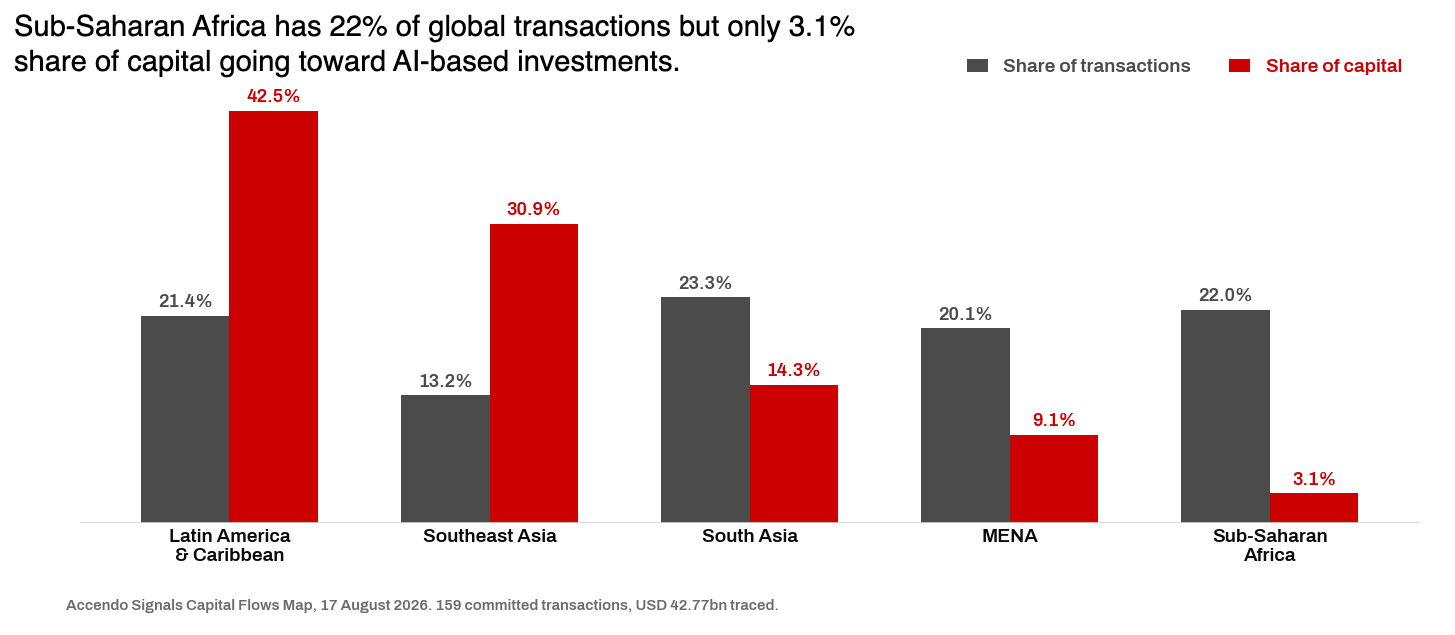
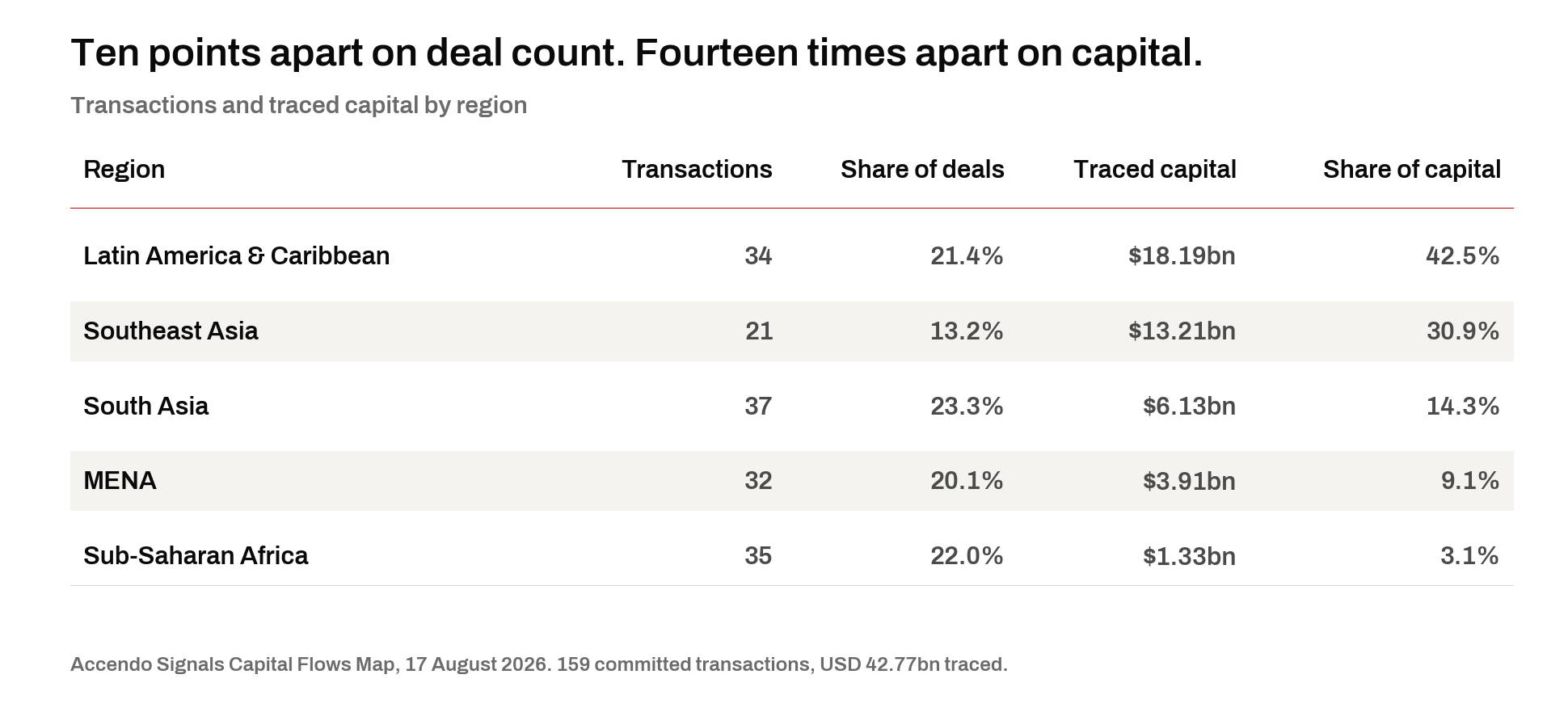
The deal counts sit in a surprisingly narrow range but the capital varies widely. Most notably, Sub-Saharan Africa has 35 transactions and Latin America and the Caribbean has 34, yet Latin America has attracted more than 13x s as much traced capital. Sub-Saharan Africa’s median disclosed transaction is USD 1.6 million.
A surprisingly large part of the regional capital gap is infrastructure wearing an AI label
Look at what it takes to host a hyperscale compute project. Reliable power at industrial scale, land, subsea cable connectivity, permitting, financing capacity, and a creditworthy customer willing to commit to enough capacity for long enough to make the economics work. Those things are not distributed equally across emerging markets.
Ceará has abundant renewable power. Johor and Batam combine power with proximity to major cable routes and to Singapore. Querétaro has become an established data-center and industrial corridor. Countries with large supplies of hydro or renewables are actively trying to turn that advantage into AI infrastructure.
So a surprisingly large part of the gap in headline AI capital is an energy, connectivity and infrastructure gap wearing new clothes. Though, not all of it is thus. Venture ecosystems matter, as do local institutional capital, market size, currency risk, exit markets, government procurement and the underlying quality of the company pipeline. But once a USD 4 billion data-center campus enters the dataset, those subtler ecosystem differences disappear inside the headline number. That is why regional rankings need to be read twice, once including infrastructure and once without it.
There is a governance gap running alongside the financing one. The second edition of the Global Index on Responsible AI finds only 27% of countries with frameworks addressing AI’s environmental effects, 83% of those non-binding, and very few governments requiring disclosure of the energy use, water use or environmental impact of AI systems. Countries are competing hard to host these assets and, for the most part, not yet requiring them to report what they consume.
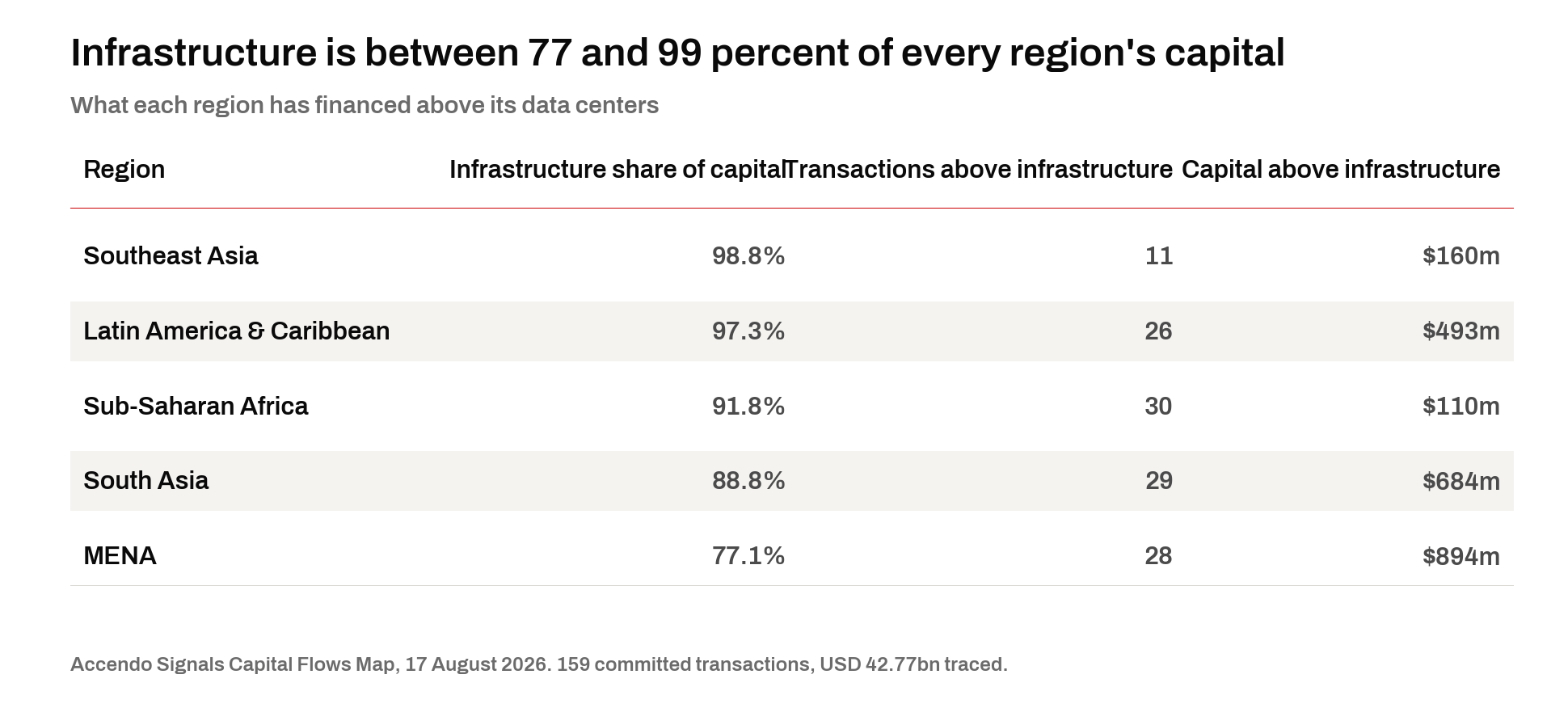
Take the data centers out and the regional ranking changes
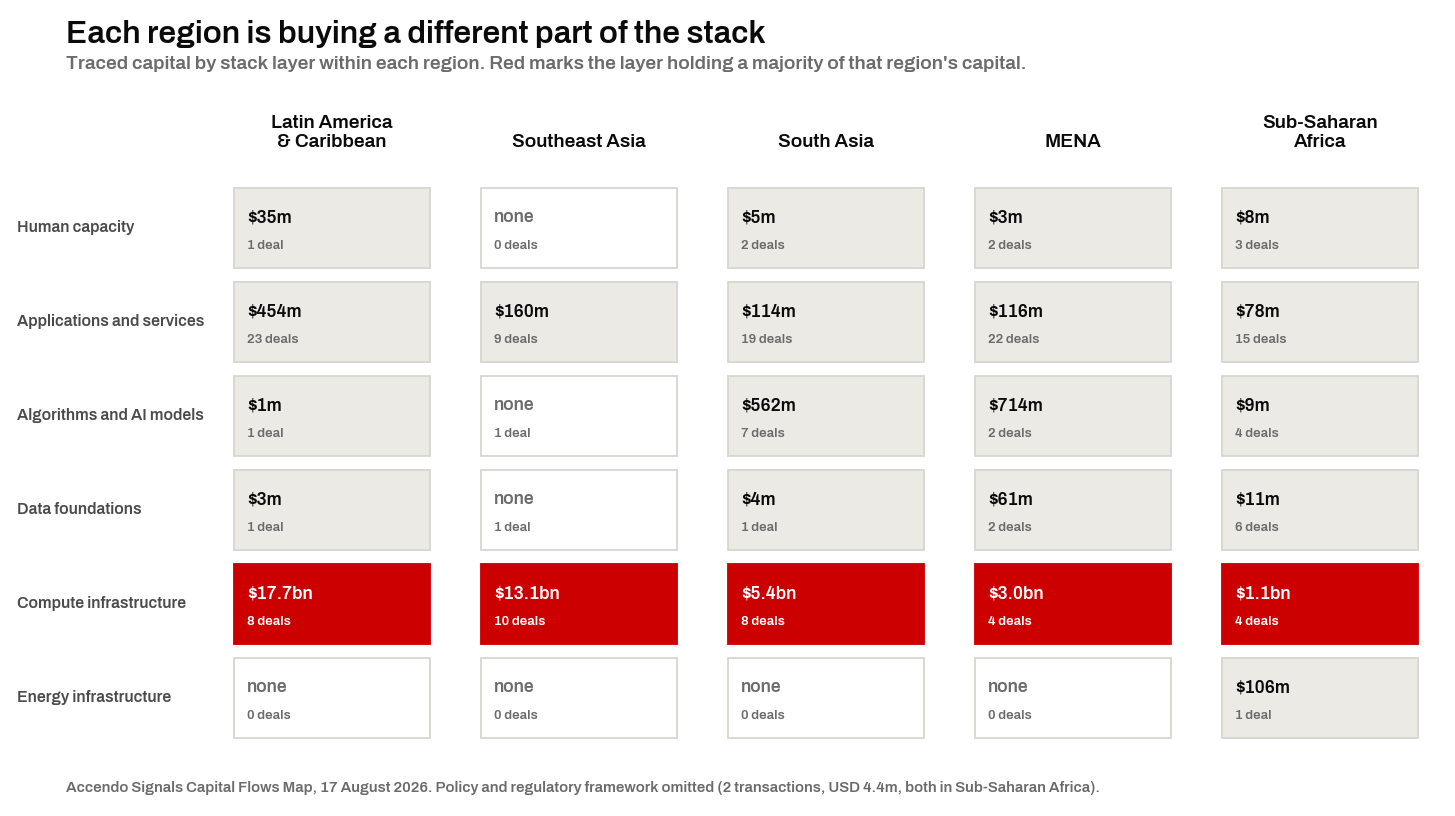
Southeast Asia holds close to a third of all the AI capital we trace. Remove infrastructure and it has about USD 160 million across eleven committed transactions. Sub-Saharan Africa holds 3.1 percent of total capital, yet it has 30 transactions above the infrastructure layer for $110m across 23 countries. MENA moves to the top of the capital table above infrastructure, with South Asia second.
Even those figures require interpretation. MENA has around USD 714 million in algorithms and models, but roughly USD 699 million of that is a single transaction, BioNTech’s acquisition of Tunisia-founded InstaDeep at up to GBP 562 million including milestones (2023 exchange rates). South Asia has about USD 562 million in models spread across seven transactions, built around Indic-language work at Sarvam, Krutrim, AI4Bharat and Uplift AI.
Those are quite different ecosystem stories. One is dominated by a very large exit. The other is distributed across several model-building companies. A regional capital total tends to erase that distinction.
Sub-Saharan Africa has 6 of the 11 data-foundations transactions in the entire database and both policy and regulatory transactions, generally on tickets of a few million dollars or less. Southeast Asia has no traced human-capacity capital and no traced data-foundations capital at all. Each region appears to be financing a different version of the AI economy.
Capital located in an emerging market is not necessarily capital building AI capability in that economy
This has become one of the distinctions I find most useful.
A hyperscale data center in Brazil, Mexico, Malaysia or Indonesia is unquestionably an investment in the host economy. It requires construction, energy, engineering, connectivity, operations, land and local services. It can improve domestic digital infrastructure and create strategic options that did not exist before. That matters.
But it is economically different from capital going into a locally founded AI business, a domestic research institution, a national language dataset or the adoption of AI by local companies. A significant amount of what gets described as AI investment in emerging markets is really AI investment located in emerging markets. Both can be valuable. They are not the same thing.
A country can host large amounts of compute without automatically creating local AI companies, local intellectual property, usable local datasets, a skilled domestic workforce, AI adoption by small and medium enterprises, or institutions capable of buying, supervising and governing AI systems. Those outcomes depend on what happens above and around the infrastructure layer. Which means the policy question cannot simply be how much AI investment a country attracted. It has to be what capability that investment created inside the economy.
We believe that compute creates potential capacity, but that capacity also needs to be funded. The layers above compute are what convert that capacity into domestic economic capability. Those layers have different economics from a data center, and they therefore require different capital.
Almost everything else in this data follows from that.
The stack is funded upside down
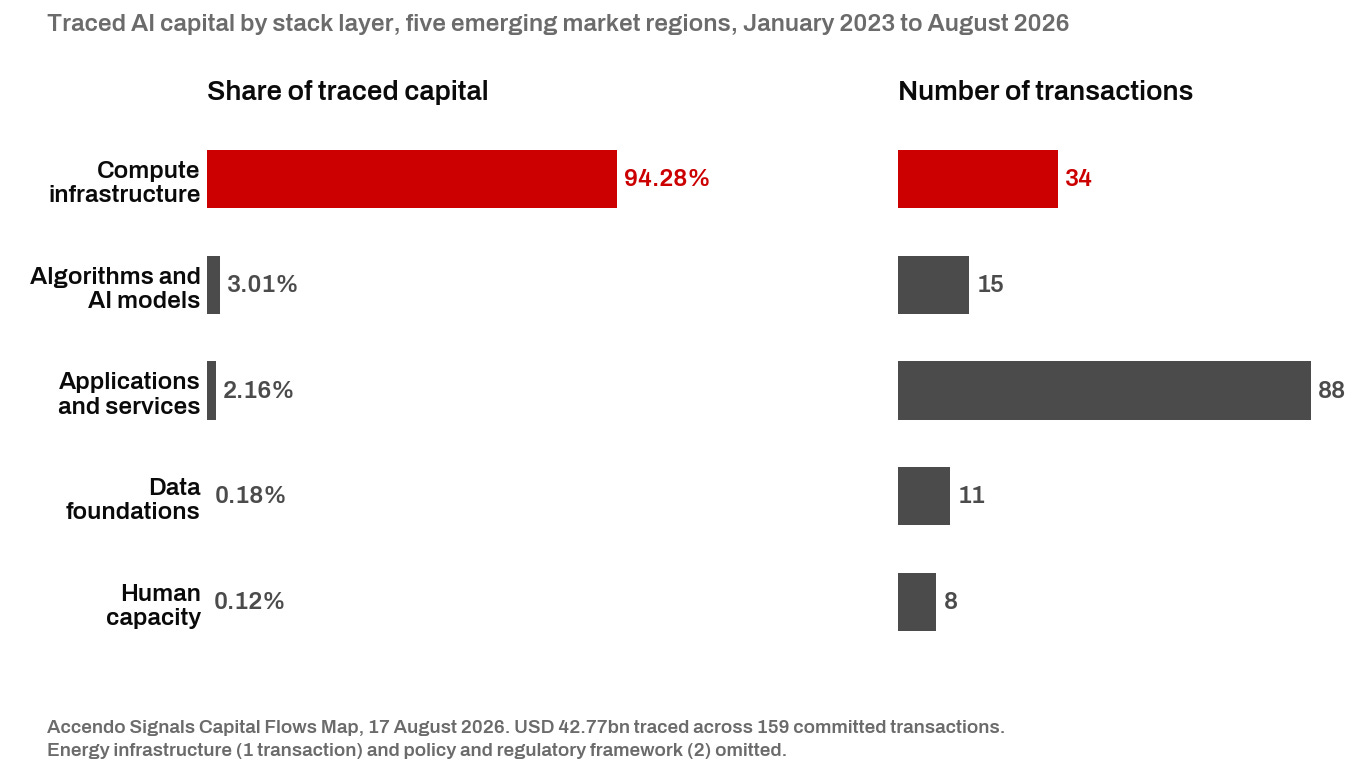
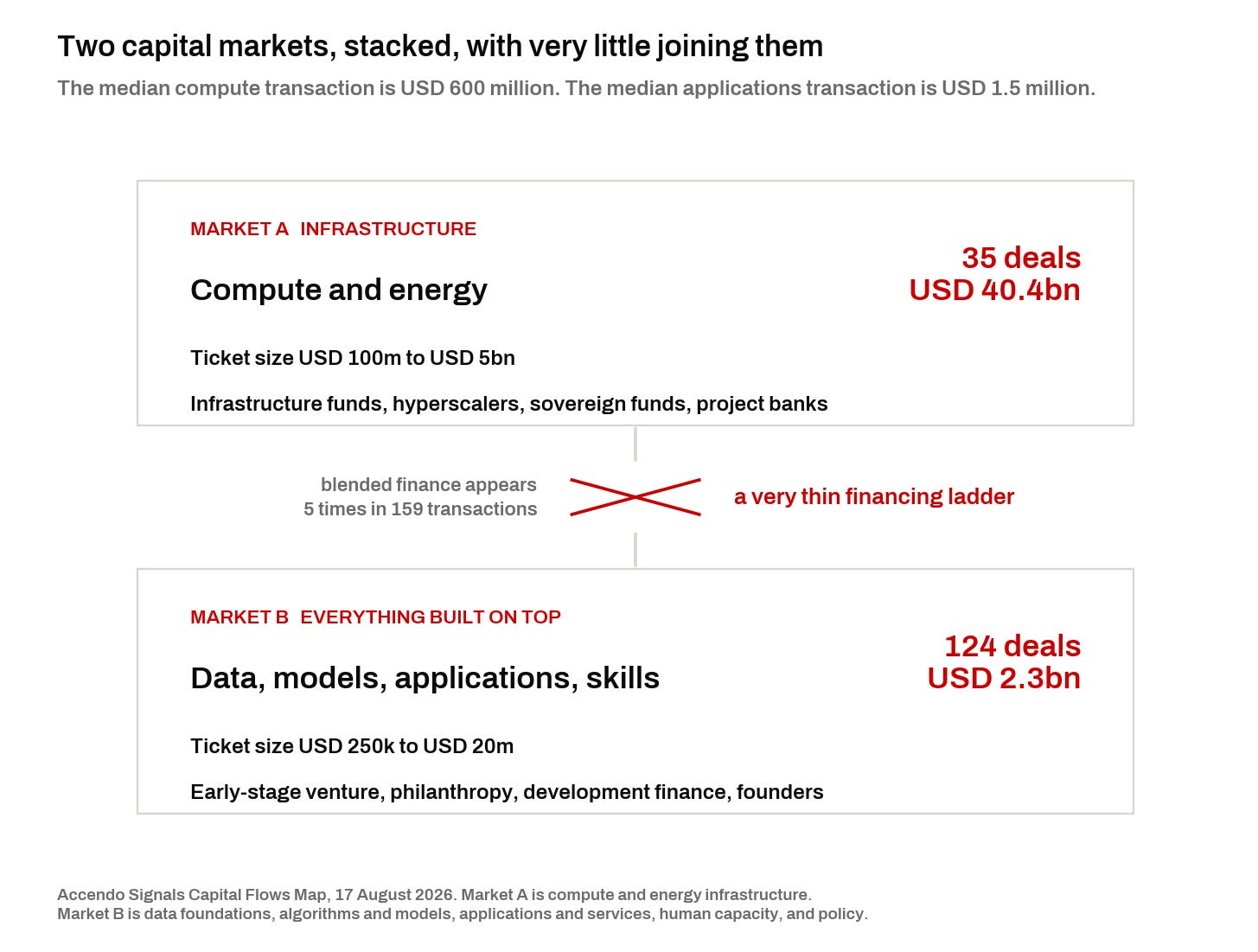
The median compute transaction ticket size is 400x the median applications transaction size. That tells us we are looking at two different capital markets. Compute has access to large-ticket capital. The ecosystem above it largely does not. That difference becomes clearer when we look at the instrument providing the money.
Corporate capital dominates the transactions we can actually trace
The public discussion about AI capital often has a strongly sovereign flavor: national AI strategies, sovereign AI, Gulf wealth funds, government-backed national champions. Those things matter enormously. But on the basis of the specific committed transactions we can trace, corporate and strategic capital is by far the largest source of money.
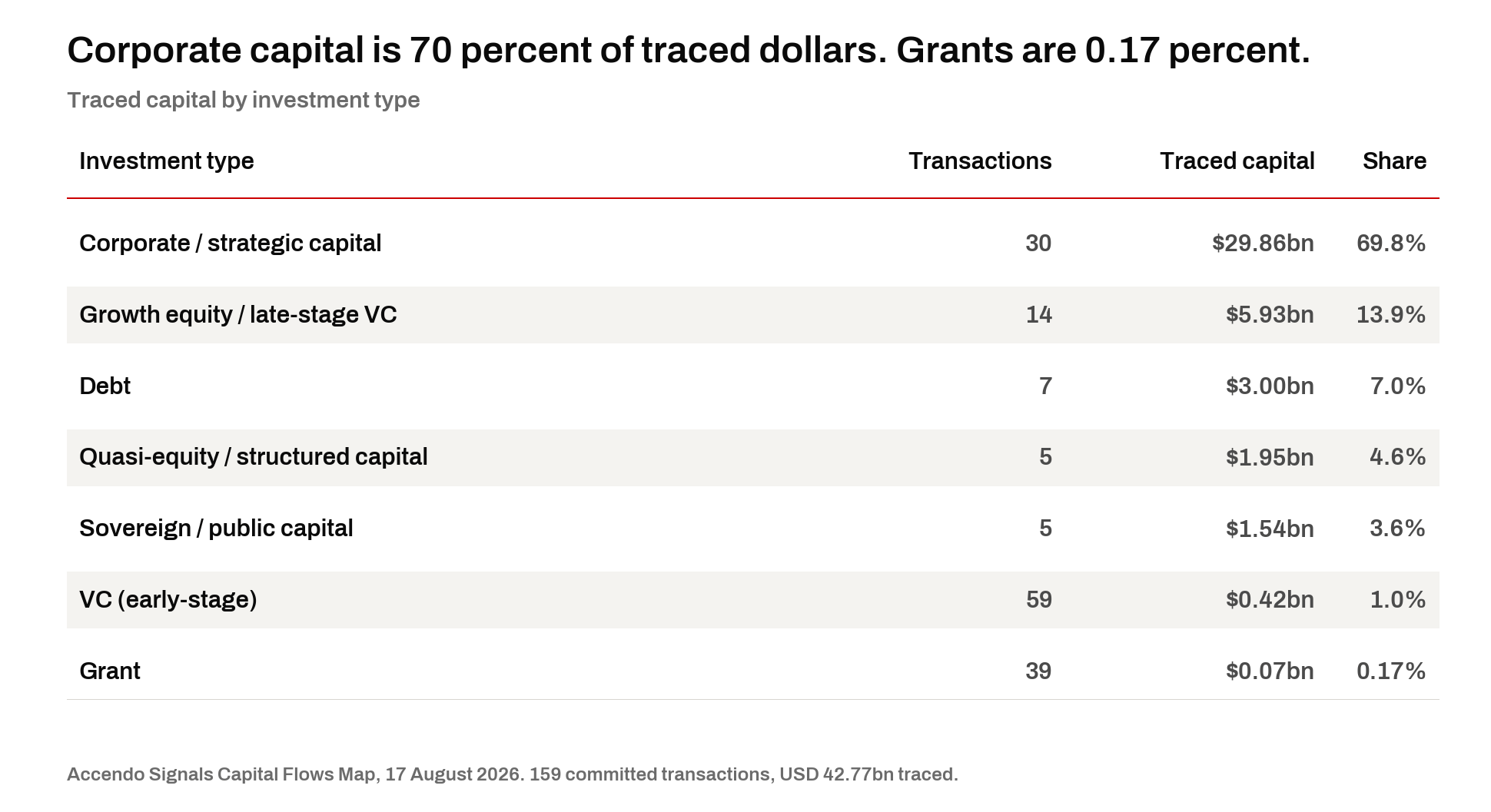
Corporate and strategic capital accounts for 70% of traced dollars. Sovereign and public capital accounts for less than 4%. The announcement universe looks different, with sovereign and public capital taking a much larger share of the USD 74 billion of committed envelopes, although corporate commitments are still larger. Corporates dominate traceable deployment. Sovereigns loom much larger in the announcement narrative.
There is an embarrassing footnote here. Until 12 August we had this wrong ourselves. Our database contained a USD 126 billion figure attached to a Gulf sovereign AI entry. An audit established that the number was Global SWF’s estimate of total deployment by seven major sovereign funds in 2025, across all sectors and all geographies. It was not an AI figure. We removed it, and the apparent funder mix changed materially.
There is probably a broader lesson in that. Very large numbers attached to AI have an unusually long “half-life”. Once one appears in a presentation or a press article it tends to travel. That is why the underlying transaction status matters.
There are two active ends of the financing market, and a much thinner middle
At the small deal end there is real activity. Early-stage venture alone accounts for 59 of the 159 transactions with a median disclosed ticket of USD 2.5 million, and grants account for another 39.
Together, early-stage and grant funding represent almost two thirds of all transactions in the database and about 1.1% of the money.
At the other end sits infrastructure, at hundreds of millions or billions, financed by debt, strategic equity and institutional capital.
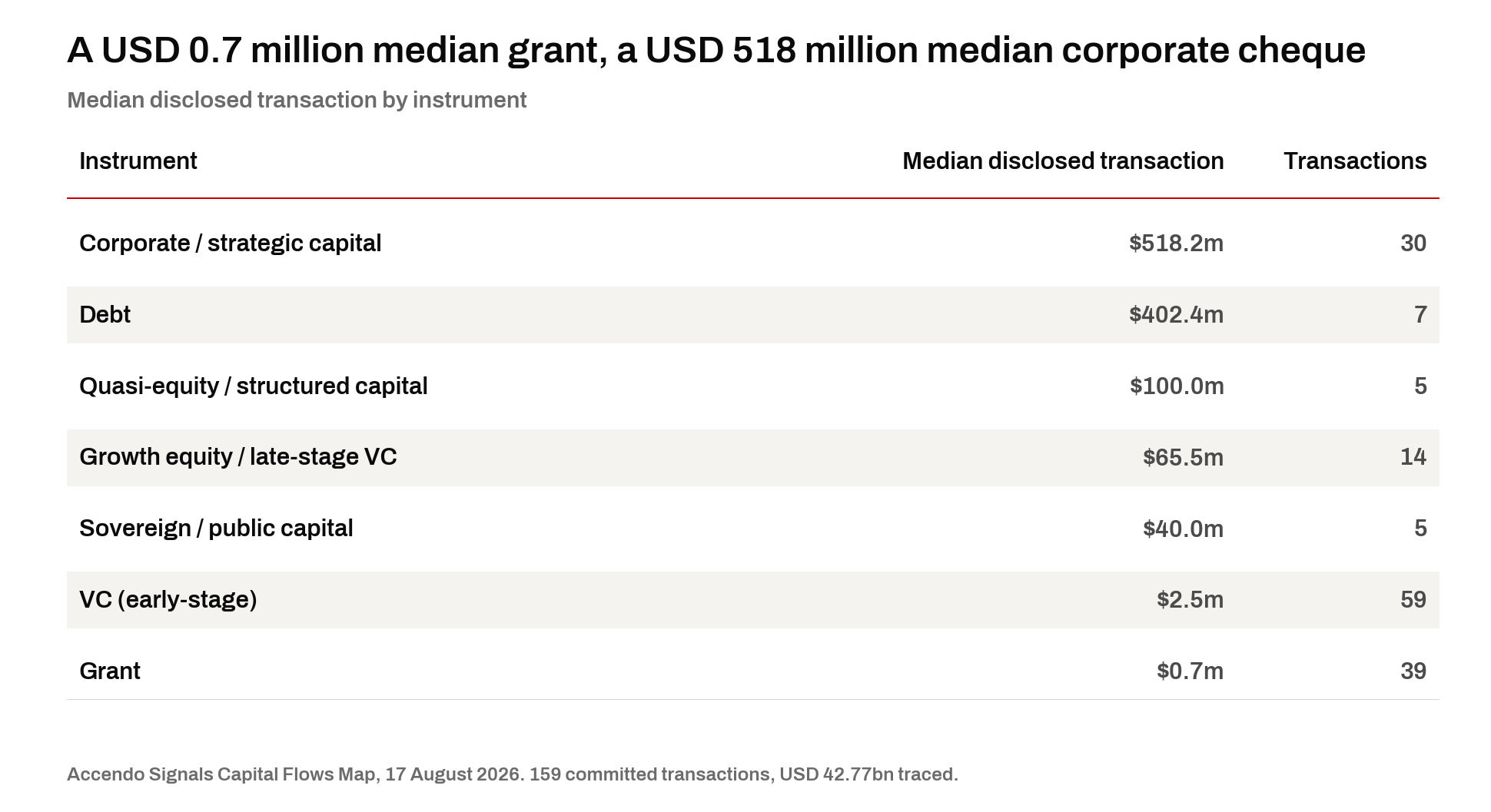
Between the two, the market becomes much thinner. Growth equity, later-stage venture, sovereign and public investment and our combined quasi-equity category together account for 24 transactions across five regions over three and a half years.
There are important exceptions. Sarvam’s USD 234 million Series B in India. Amity’s USD 100 million Series D in Thailand. Enter’s USD 100 million Series B in Brazil. Qure.ai, Helium Health, Pineapple, Tarjama, ConveGenius. The list becomes surprisingly short.
For a company in Lagos, Nairobi, Dhaka or Bogotá that has outgrown a USD 2.5 million seed round and needs USD 20 or 30 million to expand regionally, hire enterprise sales teams, meet regulatory requirements, train models and survive long procurement cycles, the observable financing routes are limited. This feels very familiar.
The missing middle that has shaped small and medium enterprise finance in emerging markets for decades appears to have re-emerged in AI. The technology is new. The capital-market problem is not.
Early-stage venture is active. The problem is what comes next.
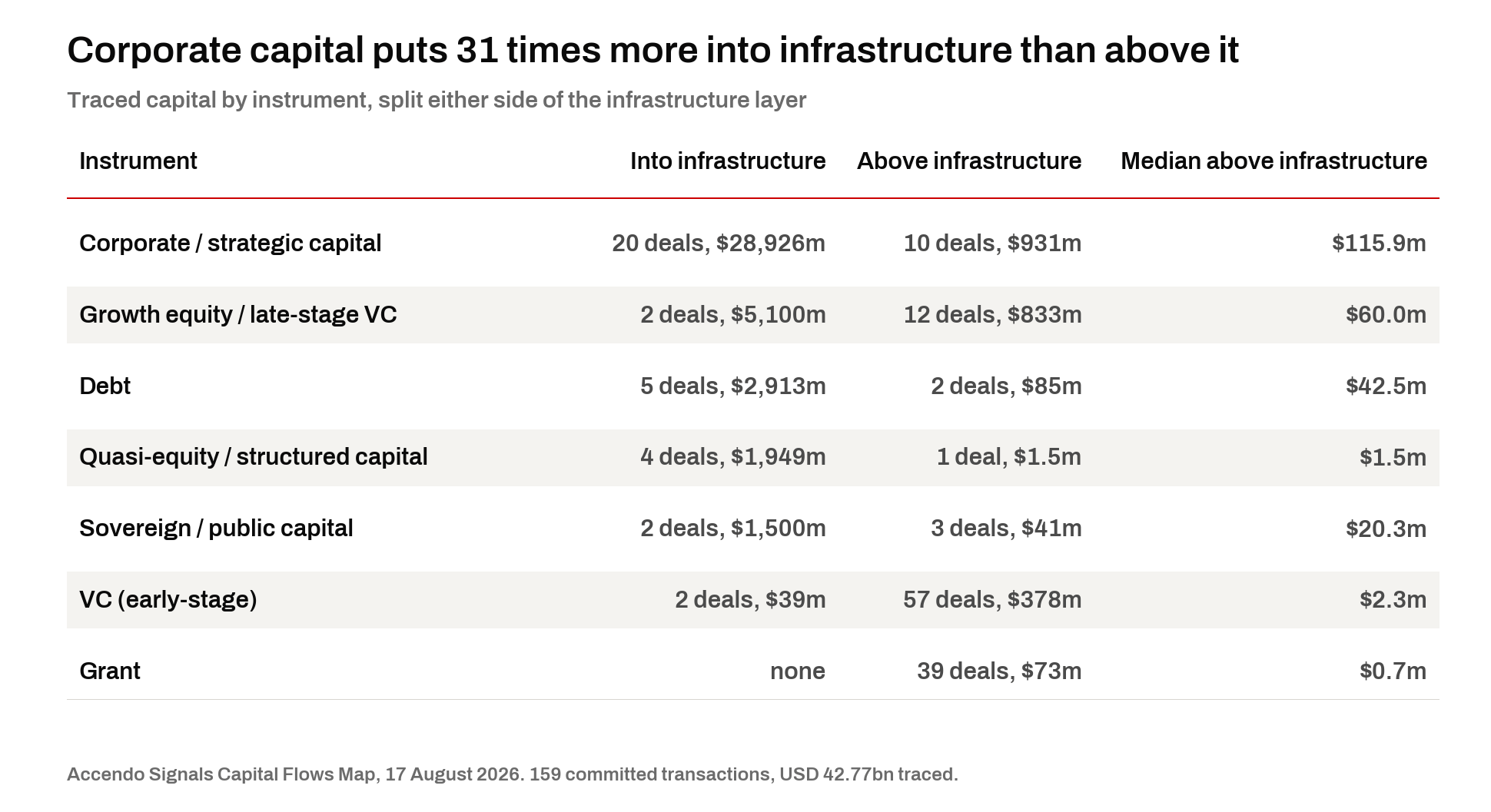
There is a risk of looking at small ticket sizes and concluding that venture capital simply is not present. The transaction count says otherwise. Early-stage venture is the single most common funding instrument in the database and it appears in every region. Of its 59 transactions, 57 sit above the infrastructure layer and carry USD 378 million between them, at a median of USD 2.3 million. The other two are early rounds into compute companies, which is why the median for the instrument as a whole is slightly higher at USD 2.5 million.
So the issue is not that nobody is taking early bets. The harder question is what happens when those bets start working. A USD 2 million round can prove a product, hire a team and win the first customers. It cannot finance three countries of expansion, regulatory approval, enterprise integrations, a lengthy public procurement cycle and several years of negative cash flow. Early-stage venture can start the journey but, as we know, it cannot finance the whole road. As always, we need a continuum of funding options.
Growth capital is where the observable market gets very thin
Between January 2023 to 15 August 2026, we could find only 12 growth-equity or later-stage venture transactions above infrastructure in the dataset, at a median disclosed value of around USD 60 million. That is the part of the market capable of turning a promising product into a company with enough scale to matter to a national health system, a bank, a government or a large regional enterprise. Twelve transactions, across five enormous regions, over three and a half years! This is what scarcity looks like.
There will be deals we have missed, undisclosed transactions and companies classified differently. Even allowing for that, the observable market looks thin, and this may be one of the most important places for development finance and impact investors to look. Not because every AI company deserves growth capital, since most may not. But because the absence of financing at that stage can turn a healthy seed ecosystem into a pipeline of companies that either remain small, move headquarters to deeper capital markets, sell early, or disappear.
Grants are tiny in dollar terms and disproportionately important in the layers nobody else consistently funds
Grant funding totals USD 72.8 million across 39 committed transactions, which is 0.17% of traced capital. Thirty-five of those 39 are in Sub-Saharan Africa or South Asia. Southeast Asia, despite holding 31% of traced capital, has no grant announcements that we could find.
Since they are supposed to be catalytic, grants show up disproportionately in the thinnest layers of the stack. They finance 6 of the 11 data-foundations transactions and 4 of the 8 human-capacity transactions globally.
Consider African-language data. The Gates Foundation’s African Next Voices initiative received USD 2.2 million to produce 9,000 hours of speech across 18 languages. Google.org committed USD 3 million to Masakhane for African-language AI. The LINGUA Africa open call creates another channel for local-language data, models and applications, although its total program pool is not disclosed. African Next Voices and Masakhane together amount to USD 5.2 million, against one USD 9.66 billion compute transaction in Ceará. SraVaani, an open-source multilingual speech-recognition AI model supporting 65 Indian languages and dialects was annouced on August 17 2026 supported by Google.
The point is not that the two should cost the same. It is that they have completely different funding markets. A hyperscale data center has customers. A dataset in 18 African languages may create value for thousands of companies, researchers and public institutions without any one of them having an incentive to finance the whole thing. That is close to a textbook public-good problem, which explains why philanthropy is there.
The Global Index on Responsible AI reaches the same gap from the opposite direction. Its second edition finds 52 governments running initiatives on local-language and culturally grounded AI, but only 47 of 135 countries with frameworks addressing cultural and linguistic diversity, and few of those requiring the entities that build or deploy AI systems to train on diverse datasets or adapt them to local contexts. Recognition of the problem is widespread, but the obligation to solve the problem is rare.
Put that next to our own numbers and the position is clearer than either dataset shows alone. Almost nobody is paying for local-language data, and almost nobody is requiring it either. There is no commercial demand and no regulatory one, which is a difficult starting point for a layer that every locally useful application eventually depends on.
What this dataset cannot tell us is whether those grants subsequently catalyze commercial capital. We can’t yet systematically link grants to later funding rounds or measure private capital mobilized after them. That is precisely the question funders should be asking. What happened after the grant? If catalysis is part of the theory of change, measure it.
One category we need to fix ourselves
There is a finding I initially thought was more dramatic than it turned out to be, and the correction matters more than the original claim.
Our current taxonomy combines quasi-equity and blended finance into a single category. Under it we have five committed transactions. Four are in infrastructure and together account for roughly USD 1.95 billion. Above infrastructure we have one transaction worth USD 1.5 million. Read quickly, that says concessional capital has gone almost entirely into data centers.
Inspect the instruments and it does not say that. The infrastructure side includes STT GDC’s KKR-led preference-share raise at USD 1.31 billion and Scala Data Centers’ preferred-equity round at USD 525 million, both commercial structured capital from private investors. The genuinely development-finance-backed transactions are much smaller: IFC’s USD 100 million facility for Raxio, which carries IDA Private Sector Window concessional co-financing, and the EBRD’s USD 14.1 million Aqaba Digital Hub financing with an EU first-loss guarantee. Above infrastructure sits IDB Lab’s USD 1.5 million convertible facility for a Mexican fintech.
So it would be wrong to look at the USD 1.95 billion and call all of it concessional capital. This is a classification problem in our own dataset and we need to fix it. The next version will separate commercial structured and quasi-equity capital from genuinely catalytic or concessional blended finance. Only then can we make a serious claim about where blended finance itself is flowing.
For now the more limited conclusion is defensible. Structured and risk-sharing instruments are rare above the infrastructure layer, precisely where the financing ladder appears thinnest, and the development-finance-backed transactions we can identify total around USD 114 million into infrastructure against USD 1.5 million above it. That is a question worth investigating rather than a conclusion worth overstating.
Once the data centers come out, this is a USD 2.3 billion market
A data center is not a health investment or an agricultural investment. It is infrastructure that can serve many sectors. So the sector question only becomes meaningful above the infrastructure layer, where the market shrinks to about USD 2.34 billion across 124 transactions.
Sector is not a field our sources reliably provide, so this is our classification rather than a reported one. We have published the call on every transaction so that anyone who disagrees can see exactly which one they are disagreeing with.
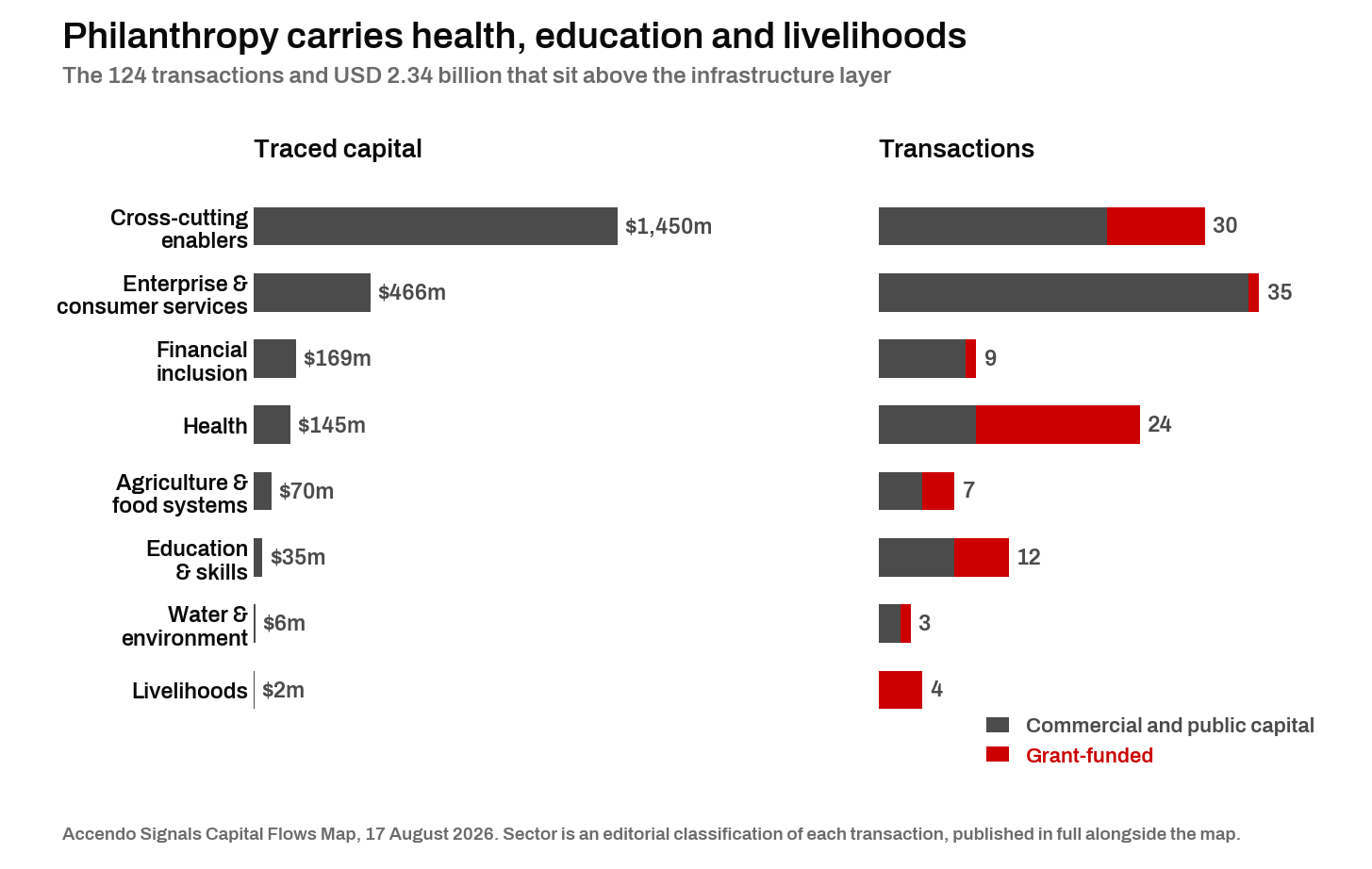
Cross-cutting enablers, meaning language data, general-purpose models, research capacity, governance and public digital infrastructure, account for 62 percent of the capital above data centers. Strip out the InstaDeep acquisition and they still account for 46 percent, driven by Sarvam, Krutrim, CNTXT AI and Tarjama. Local-language and local-model capability is one of the few areas above infrastructure where commercial capital is arriving at scale, and it is highly concentrated geographically and institutionally.
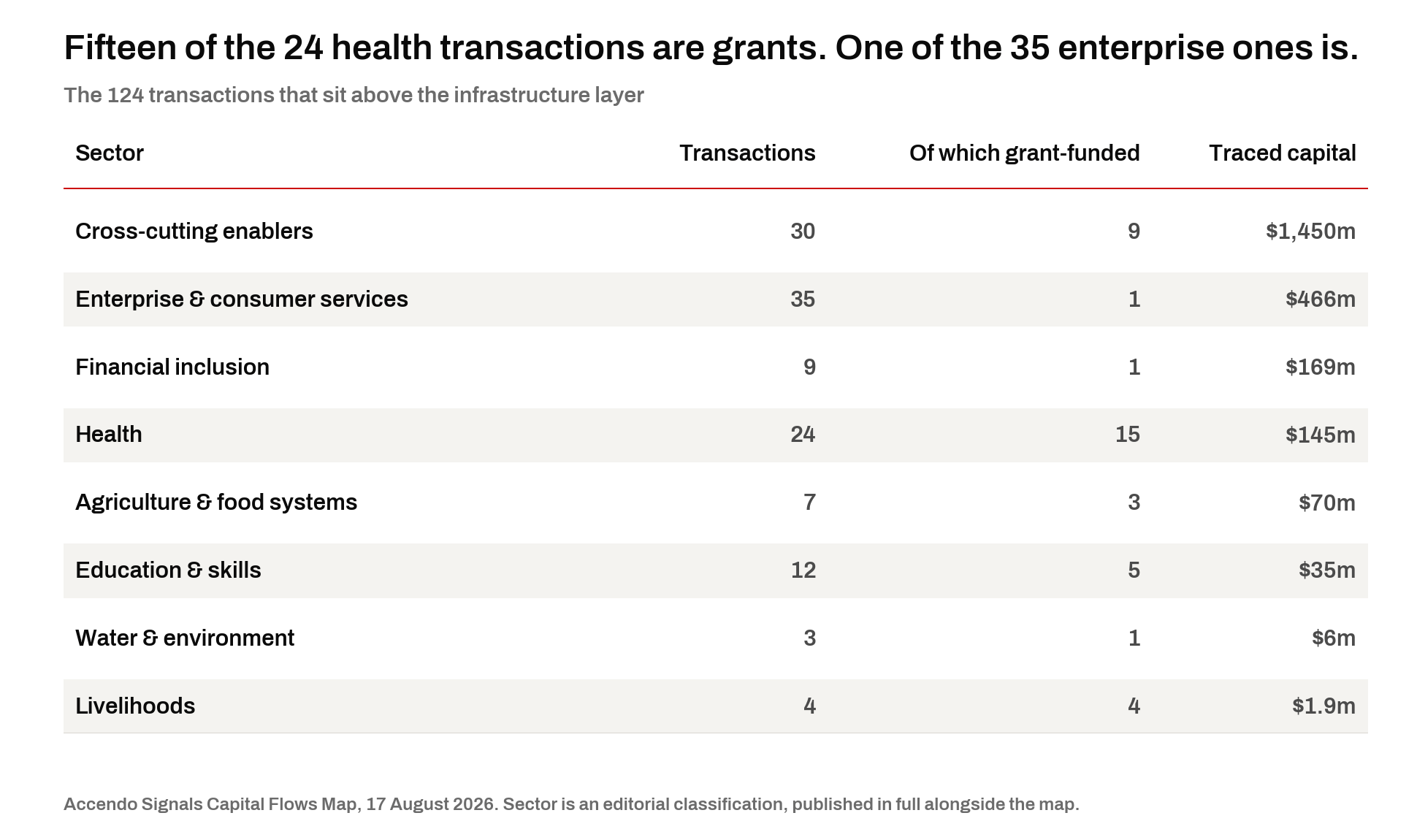
Now read the grant column next to the transaction count. Of 35 enterprise and consumer-services transactions, one is a grant. Of nine financial-inclusion transactions, one is a grant. Of 24 health transactions, 15 are grants. All four livelihoods transactions are grants, and together they total less than USD 2 million.
Health has the second-highest number of transactions above infrastructure and receives around 6 percent of the capital there, at a median ticket of roughly USD 750,000. Agriculture and food systems, which employs the largest share of the workforce across most of these countries, has only seven transactions announced since January 2023.
By region the pattern repeats. Latin America’s money above infrastructure is enterprise software at USD 253 million and financial inclusion at USD 139 million. MENA’s is enablers at USD 777 million. South Asia’s is enablers at USD 563 million, then health at USD 71 million. Sub-Saharan Africa’s largest sector above infrastructure is health at USD 46 million, overwhelmingly philanthropic.
This looks less like a sector distribution than a funder distribution. Where commercial capital can see enterprise customers, financial institutions and plausible exits, it shows up. Where the end user is a health system, a farmer, a public institution or a low-income worker, grant capital becomes much more prominent. That does not prove those sectors are commercially unviable. It tells us how today’s capital providers are currently pricing them.
Every actor is doing something the others cannot
Both halves of this market have funders. They are mostly different funders.
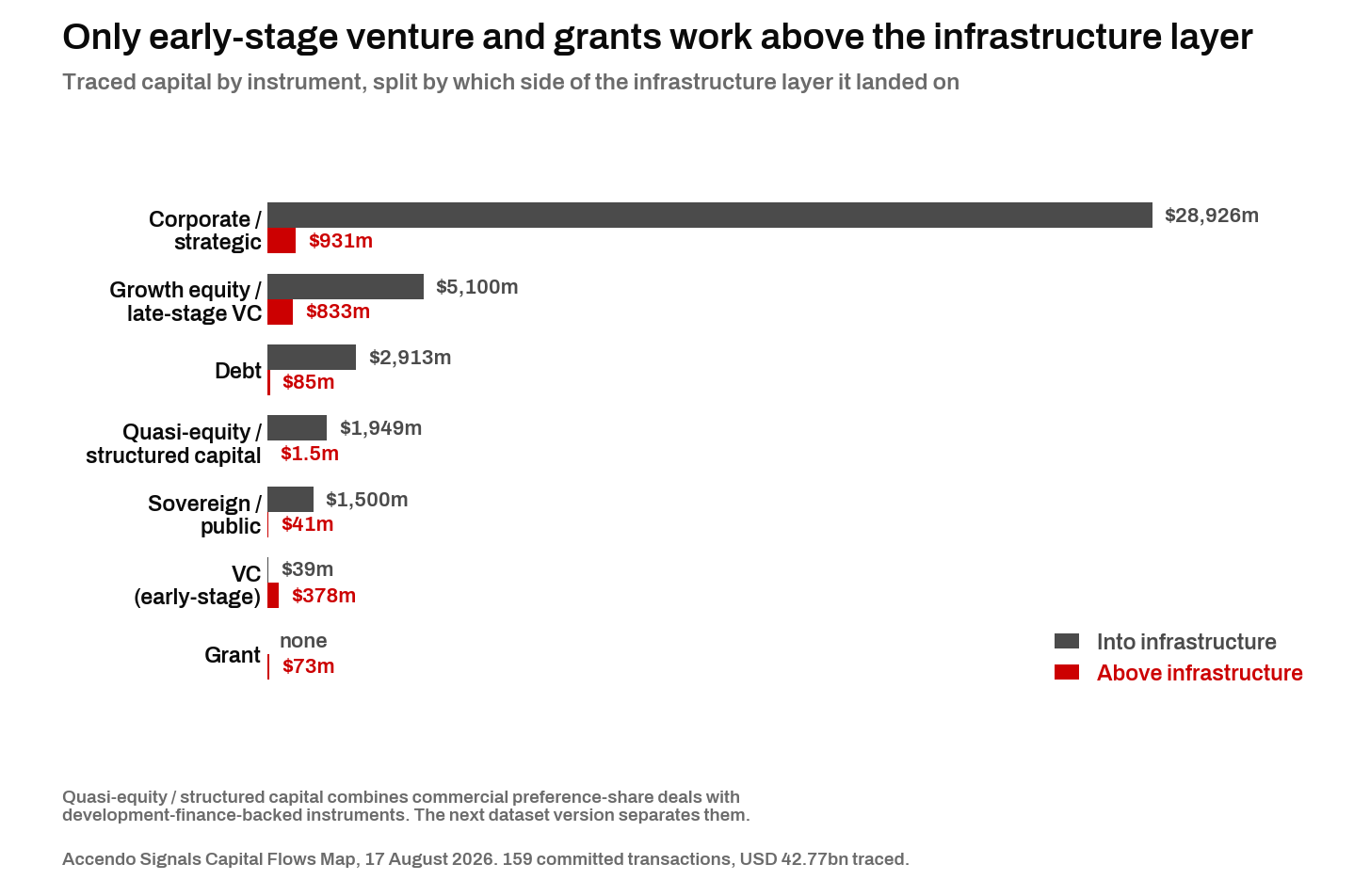
Corporate and strategic capital is the only actor currently deploying infrastructure capital at industrial scale, carrying nearly USD 29 billion across 20 transactions.
Above infrastructure it plays a second role, which is exit. BioNTech buying InstaDeep, NVIDIA buying VinBrain, Presight taking control of AIQ. Those transactions matter because venture investing needs a route to liquidity, and a startup ecosystem with no plausible strategic buyer struggles to sustain a venture-capital market. What corporate capital generally does not finance is the part of the stack with no near-term commercial customer.
Growth equity and late-stage venture is the scale-up market, and we discussed its “thinness” earlier. Early-stage venture is present almost everywhere and doing what it is supposed to do. Grants reach parts of the stack that no other funder consistently touches, which makes them both essential and precarious.
Sovereign and public capital shows the widest gap between stated ambition and observed transactions: five traced transactions, three of them above infrastructure, USD 41 million between them, against a prominent position across the envelope universe. The intent is visible. The conversion into identifiable transactions is much less so.
Debt finances buildings and little else, with five infrastructure transactions at USD 2.9 billion and two above it. This is entirely rational, because debt needs cash flow and something to secure against, and a data center provides both where a dataset or an LLM or other AI tool usually cannot. But it means the cheapest large-scale capital in the market is structurally unavailable to many of the layers that need patient financing.
Read down that list and the shape of the problem changes. The layers above compute are being funded. They are being funded at a fraction of the scale, by pools of capital whose economics do not allow any of them to finance the whole journey. Grants can pay for public goods but cannot scale a company. Early-stage venture can pay for experimentation but not for a decade of it. Debt needs cash flow that an AI dataset does not produce. Corporates finance what is strategically valuable to them, which is not the same as what is developmentally valuable to the host country. Governments announce at scale and deploy at a fraction of it. None of these is behaving irrationally. Each is doing the thing its own economics permit.
This is ultimately an absorptive-capacity problem as much as a compute problem
A great deal of the global AI-divide conversation understandably focuses on access to compute. Countries without affordable computing capacity are disadvantaged, and that is real. But these capital flows point to another divide, which is absorptive capacity.
Whether domestic firms can actually use the compute. Whether they have usable data. Whether models work in the languages people use. Whether companies have the people required to redesign operations around AI. Whether a public hospital can procure and supervise an AI system, a small business can afford one, and a regulator can approve one. Whether a local AI company can survive a two-year enterprise sales cycle. Whether research can become a product, a product can become a company, and that company can raise growth capital.
Those are questions about the layers above compute, and those are the layers receiving a small fraction of the capital. Absorptive capacity is what turns compute located inside a country into capability embedded inside its economy. A country can host a very large amount of compute and still struggle to develop a meaningful domestic AI economy around it. That is why the AI infrastructure race cannot end at infrastructure.
Somebody has to consume all this compute
There is also a straightforward commercial reason to care about the layers above the infrastructure. If billions of dollars of compute capacity are built across Brazil, Malaysia, India, Indonesia, Saudi Arabia and elsewhere, somebody eventually has to use it. Utilization is the business model. GPUs need workloads, cloud regions need customers, data centers need tenants.
Which means hyperscalers, infrastructure investors and governments have a direct interest in creating the demand side of the AI market: enterprise adoption, developer communities, local models, usable datasets, small business adoption, public-sector workloads and startup formation.
A hyperscaler supporting a local developer ecosystem may look like philanthropy or corporate affairs. It is also market creation. A government investing in domestic AI adoption while attracting a data-center campus may look like industrial policy. It is also demand generation for the asset sitting underneath it. This is one of the places where commercial and development incentives line up rather neatly. We spend a lot of time talking about financing the supply of AI. We should probably spend more talking about financing demand for it.
So what would change the shape of this market?
The data does not tell us exactly what to do next. But it points to several places where intervention would be logically connected to the gaps we can observe.
1. Build a growth-capital bridge
There is a visible gap between the USD 2 to 3 million early-stage market and the much smaller number of later-stage transactions. A facility targeting perhaps USD 10 to 40 million tickets could sit directly in that space, anchored by development finance institutions and impact investors, combining risk-tolerant capital with commercial co-investment.
The important part would be measurement. If the thesis is that concessional or catalytic money brings private investors behind it, publish the mobilization ratio. For every dollar of risk-tolerant capital, how much genuinely commercial capital followed? Do not make catalysis a story. Make it a number.
2. Treat local-language data as shared infrastructure
Data foundations account for only USD 79 million of traced capital across eleven transactions, which is tiny relative to compute. But datasets and local-language resources can underpin thousands of applications, which suggests a different funding model. Rather than repeatedly financing isolated projects, governments, philanthropies, development finance institutions and hyperscalers could pool capital into standing regional facilities for datasets, language resources, evaluation infrastructure, model adaptation and open research assets.
The difficult questions would not primarily be technical. Who owns the data, who consented to its use, who can access it, what remains open, who has the right to correct it, and who benefits economically. Those decisions are made at funding time.
3. Attach demand creation to large infrastructure commitments
When governments negotiate major compute investments, they negotiate power, land, tax, connectivity and permitting. Perhaps there should be another negotiation, about what happens above the infrastructure: local developer programs, enterprise AI adoption, public-sector workloads, small business access, university partnerships and support for domestic AI companies. Not as corporate social responsibility added afterwards, but as part of the economic bargain around the infrastructure.
A small share of a multi-billion-dollar project committed to building domestic demand could be meaningful relative to the amounts currently flowing into data, skills and applications. It would also protect utilization of the underlying asset.
4. Treat procurement as a financing instrument
One important caveat in our dataset is that public procurement is largely invisible. A government buying an AI service is not usually reported like a venture round, so we cannot infer from its absence here that it does not exist. But conceptually it matters enormously.
A company that has proved an AI health product may not need another pilot grant. It may need a health system to buy it. A multi-year customer contract provides revenue, evidence, a reference client and potentially a cash flow against which future capital can be raised. Development finance institutions and foundations could help underwrite the risk of early contracts rather than funding repeated demonstrations of the same technology. At some point, if the product works, somebody has to buy it.
There is also a question of ownership and agency
The capital story is not only about growth. The thinly financed layers, meaning data, skills, models and policy capacity, are also where societies establish agency over AI.
Who controls the underlying data. Whose languages are represented. Who can inspect a system. Who can challenge an automated decision. Where the technical capability to adapt a model sits. Who owns the intellectual property. Who can switch supplier.
Those questions have economic consequences and they have governance consequences. A country can import world-class AI systems, and that is not the same thing as having the capability to understand, adapt and govern them. Underinvestment in the layers above compute is not simply a startup-finance issue. It shapes who ultimately has agency over the technology.
That is measurable, and somebody has now measured it. The Global Index on Responsible AI scores 135 countries on whether governance commitments reach the people most exposed to AI, and finds an average of 55 in Global North countries against 27 in the Global South. Of the responsible AI framework cases it identifies in Global South countries, 78 percent are non-binding, against 42 percent in the North.
Robert Opp, Chief Digital Officer at the United Nations Development Programme, puts the reason plainly in his foreword to that report. Low implementation scores in developing countries, he writes, “reflect structural conditions: infrastructure, financing, technical evaluation capacity, institutional bandwidth, and bargaining power within global AI ecosystems. Implementation gaps, in many contexts, are development gaps.”
A governance index arriving at a financing conclusion, from an entirely different method than ours, is worth more than another quarter of our own data would be.
Announcements should be tracked, not just celebrated
There is one other place this database may become useful over time. Announcements are not meaningless. A large national strategy or corporate commitment tells us something about intention. But intention should eventually encounter reality.
Our current dataset separates committed capital envelopes from specific transactions precisely because the two cannot safely be treated as equivalent. Over time we should be able to do something more useful, which is to link individual transactions back to the envelopes they sit within. Then we can start asking how much of a USD 5 billion strategy actually reached identifiable projects, how quickly, through which instruments and into which layers of the stack.
At the moment the parent-child linkage in the dataset is not complete enough to calculate that conversion rate reliably, so we will not pretend we can. But building it is an obvious next step. The interesting metric may eventually be not what a country announced, but how effectively it converted the announcement into transactions.
What this dataset cannot tell you
The first limit is coverage. We do not have something like a Crunchbase or PitchBook for this sector, so the map depends on public reporting. Large deals are easier to find than small ones, and undisclosed deals show up without values. Of the 159 committed transactions, 15 have no disclosed amount. Those count in our deal numbers but not in the USD 42.77 billion. The same issue exists with envelopes, where 53 committed envelopes include 48 that disclose a value.
Second, language matters. A French and Spanish historical sweep added 22 transactions and nine countries that earlier English-language searches had missed, which is a useful reminder of how much an English-only capital map can miss. Portuguese, Arabic, Bahasa Indonesia and Mandarin are now part of the search matrix but have not yet been comprehensively swept across the entire historical period. The map will change.
Third, committed money is not deployed money. We record the transaction as it was publicly announced and we do not follow every dollar through disbursement, construction, deployment and eventual performance. Execution risk can be enormous. Five records in the broader database are already classified as stalled, carrying announced values of roughly USD 26.85 billion.
Fourth, the classifications are analytical choices. What is primarily compute and what is primarily models. Whether a company is genuinely AI-first or simply using AI as part of its product. Where a cross-cutting national program should sit. Those are judgment calls, and our preference is to make the classification visible so somebody who disagrees can see exactly what they are disagreeing with.
Fifth, some economically important flows are naturally difficult for a press-based methodology to capture: public procurement, internal corporate spending, compute credits, in-kind technical assistance and government research budgets. All may be meaningful.
For those reasons I describe the map as directional rather than comprehensive. I would rather make a narrower claim that survives scrutiny than a larger one that does not.
The map is public. And it will be wrong in places.
The Accendo Signals Capital Flows Map is public. Every entry carries its source, and it can be filtered by region, country, stack layer and investment type. We update it monthly, and we expect people to find things we have missed. That is part of the point.
If you funded a transaction that is not there, tell us. If we have classified your transaction wrongly, tell us. If the amount changed, tell us. If you have a better source than the one we used, send it. We will check it. A useful dataset should improve when people challenge it.
Where this leaves me
We started trying to answer what sounded like a simple question. Where is the money funding AI in emerging markets?
We found much more of it than I expected, and we also found that the scarcity people describe is very real. Those findings are not contradictory. They are true of different parts of the same economy.
There is a sophisticated and increasingly deep capital market capable of financing large-scale compute. There is an active early-stage market funding founders and experimentation. There is grant capital supporting things commercial markets struggle to finance. There is a much thinner layer of growth capital connecting promising companies to scale. And there is very little money, relative to compute, going into the capabilities that determine whether countries can do much with the infrastructure once it arrives.
So I no longer think the most useful question is how much AI capital is reaching emerging markets. The better questions are what kind of capital it is, which part of the stack it is financing, whether it is merely located in the country or building capability inside the economy, who owns what gets built, what the route is from seed to scale, and what happens after the data center arrives.
The winners in AI in emerging markets may not be the countries that attract the largest compute commitments. They may be the ones that turn compute inside their borders into capability inside their economies: usable data, relevant models, skilled people, viable companies, institutional demand and applications that solve real problems.
Which leaves the question this dataset keeps pointing at without being able to answer. Who pays for that conversion? Compute has a commercial model and has found its capital. Venture has a commercial model and has found its capital. What is thin is the money capable of financing the space between the two: shared data assets, institutional capability, early demand, procurement risk, and the growth-stage companies that turn a working product into a service an institution can rely on. Those are the places where private returns and developmental returns do not line up neatly enough for ordinary capital to solve the problem on its own, which is the textbook definition of where development finance and impact capital should hold an advantage. On the evidence of these 159 transactions, that advantage is not yet being used.
The next billion dollars matters. What it finances, and what it unlocks, matters more.
The Accendo Signals Capital Flows Map tracks publicly reported AI-related capital across Sub-Saharan Africa, South Asia, Southeast Asia, Latin America and the Caribbean, and MENA from January 2023. Figures in this piece are as of 17 August 2026: 254 published records; 159 specific committed transactions, of which 144 disclose amounts totaling USD 42.77 billion; and 53 committed capital envelopes, of which 48 disclose amounts totaling USD 74.01 billion. Deals and envelopes are analyzed separately and are never added together as a single capital total.
Responsible AI governance figures are drawn from Adams, R., Adeleke, F., Alayande, A., Abdella, S.E., Florido, A., Junck, L., and Grossman, N. (2026), Global Index on Responsible AI 2026, 2nd Edition, Global Center on AI Governance, which assesses 135 countries against more than 68,000 data points for the period 1 November 2023 to 30 September 2025. It is an independent piece of work and the analysis here is ours, not theirs.
Prateek Shrivastava is Managing Partner of Accendo Associates and co-founder and co-chair of the Alliance for Inclusive AI. Accendo Signals publishes on AI capital, policy and adoption in emerging markets. The Capital Flows Map is free and open.